
How Deep In The Ground Is Wine Cellar
How Deep In The Ground Is wine cellar is a practical question for anyone planning a stable wine storage space. An underground wine cellar does not need to be extremely deep, but it must be deep enough to reduce daily temperature changes, avoid direct heat, and support proper insulation. In many projects, a basement-level room or a partly underground space can work well when cooling, sealing, and humidity control are planned correctly.
WSET wine storage guidance recommends keeping long-term wine storage at around 10°C to 15°C, because stable temperature is more important than making the room very cold. Wine storage references also commonly suggest humidity around 50% to 70% to help protect cork condition and reduce drying risk.
For a traditional underground wine cellar, 2.4m to 3m below ground can usually provide better thermal stability than a shallow room. However, depth alone cannot replace professional design. Soil temperature, local climate, waterproofing, drainage, wall insulation, ventilation, and door sealing all affect the final result. A shallow cellar with professional cooling may perform better than a deep cellar with poor sealing.
Project Type / Suggested Depth / Professional Advice
Basement wine room / Below ground level / Add insulation and cooling control
Semi-underground cellar / About 1.5m to 2m / Suitable for compact private or hospitality spaces
Traditional wine cave / About 2.4m to 3m or deeper / Better natural stability, but needs waterproofing
Modern glass cellar / Not depth-dependent / Requires insulated glass, sealing, and active cooling
Winton supports Custom Wine Cellar design for different building conditions. Our wine cellar solutions can maintain 8°C to 18°C and use UV protective glass doors to help reduce harmful light exposure. For projects that cannot go underground, we can also provide Wine Cooler cabinet options, built-in wine cabinets, and display-style wine storage systems.
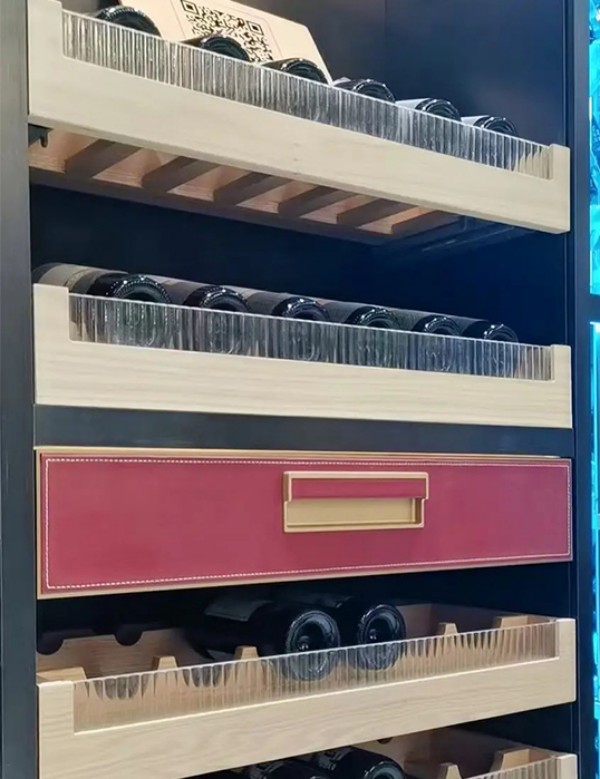
For example, our wine cooler cabinets use double-layer hollow tempered glass to improve insulation and UV protection, helping the cabinet maintain stable internal conditions while still presenting the bottles clearly. Our team can review room drawings, bottle quantity, voltage requirements, glass area, and installation conditions before production, so the wine cellar is planned around real site needs rather than only appearance.
A good wine cellar is not decided by depth alone. It is decided by temperature stability, moisture control, insulation quality, cooling design, and long-term maintenance convenience. Send us your project size, target bottle capacity, and installation environment, and our team can help match a practical custom wine cellar solution.
Previous: How Deep Should A Wine Cellar Be